

ASSESSMENT OF THE SOCIAL AND ECONOMIC IMPACT OF THE PROJECT
This line of activity has developed an integrated methodological path aimed at the socio-economic evaluation of the upcycling supply chain of textile microfibers into nanodiamonds, taking as a reference the five interconnected domains of sustainability (economic, social, environmental, technological and institutional, as shown in Figure).
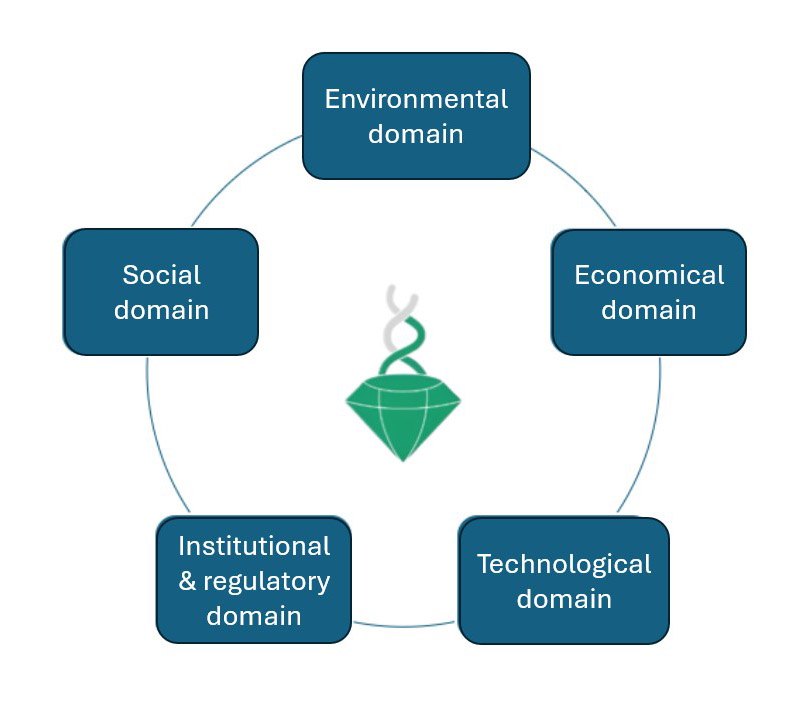
Relevant domains for the nanodiamond microfiber upcycling supply chain
The work began with the construction of a systemic baseline, aimed at describing the contextual conditions, interdependencies, and key variables influencing the feasibility of the supply chain. On this basis, through an interdisciplinary co-creation process, plausible scenarios were developed that integrate operational dimensions (collection, management, governance, EPR, filters, facilities, incentives, and communication) within a framework consistent with the logic of systemic sustainability. The identified qualitative areas were subsequently translated into measurable criteria, building an evaluation framework capable of integrating quantitative and qualitative data from three empirical streams: expert consultation (Delphi method, a qualitative research technique that gathers the opinions of a group of experts on a given topic through a series of anonymous and interactive questionnaires), which defined the regulatory coherence, technical feasibility, and institutional soundness of the models; national survey, which measured citizens' acceptability, trust, and preferences in relation to different collection methods; and the territorial pilot simulations, which provided economic, management, and employment data in two local contexts (Pisa and Treviso). By integrating this evidence, a multi-criteria matrix (MCDA) was constructed across five domains. The criteria were divided into two categories: (i) scenario-specific, which vary depending on the collection method (door-to-door, drop-off point, postal delivery); (ii) fixed, which represent constant structural conditions (environmental, technological, institutional) and do not depend on operational methods, while maintaining their own numerical values.
The environmental component was integrated with the information flow from Life Cycle Assessment studies, which was consistent and positive across all scenarios. The final matrix, based on criteria normalized on a scale of 1-5 and weighted according to expert consensus, allowed us to develop a synthetic overall sustainability index for each configuration. The results showed substantial equivalence between the "door-to-door" and "delivery point" scenarios, both with an average sustainability score of approximately 3.7 out of 5, while postal delivery is lower (≈3.5), due to high logistics costs and low organizational efficiency. The delivery point emerges as the most economically efficient option (highest ROI), while door-to-door has the greatest social acceptability and the greatest employment impact. In all scenarios, the environmental and health benefits are consistent and positive, confirming the technology's net contribution to reducing microfiber shedding. The technological and institutional dimensions achieved medium-high scores (3.4–3.5 out of 5), indicating the model's long-term robustness. Overall, these studies highlight that supply chain sustainability does not depend on single variables, but on the dynamic balance between economic efficiency, social inclusion, and institutional coherence, on a stable and shared technological and environmental foundation.
 |
THE RESEARCH TEAM |
|
|
Andrea Appolloni |
||
 |
Associate Professor at the University of Rome Tor Vergata, Dept. of Management and Law. Specialized in Operations and Sustainable Supply Chain Management, he teaches Operations Management and Sustainable Supply Chain Management and has extensive experience in research projects and collaborations with international companies and organizations. |
|
|
Natalia Marzia Gusmerotti |
||
|
Tenure Track researcher at the University of Rome Tor Vergata, Dept. of Management and Law. Her research is focused on sustainable management, circular economy, and innovation for sustainability, across various sectors, including environmental policy, corporate sustainability, and transition to circular business models. |
 |
|
|
Sophia de Assis Bombardelli |
||
 |
Research fellow of this project, she held a Bachelor in Political Science and International Relations and a Master's in Social Studies of the Environment and Sustainability at the Instituto Universitário de Lisboa, Portugal. She is currently involved in European-level projects on social economy. |
|